Study Abroad Under 30 Lakhs: 2027 Country & Budget Guide
Yes, studying abroad under ₹30 lakh can still be possible in 2027—but only if you choose the right country, course, and financial strategy.
Recent data shows that 7 in 10 Indian aspirants now plan their overseas education with a budget strictly below ₹30 lakh. Affordability, career outcomes, and visa clarity have completely replaced the blind pursuit of famous university brand names. However, inflation, rising visa fees, and increased government proof-of-funds requirements mean that a ₹30 lakh budget must be engineered with absolute precision.
If you are a career-driven student aiming for a high return on investment (ROI), you cannot afford costly miscalculations. Here is the realistic blueprint for securing your 2027 intake without crossing the ₹30 lakh threshold.
What Does a ₹30 Lakh Study Abroad Budget Actually Include?
A common trap Indian students fall into is equating their entire budget with the university tuition fee. If a university charges ₹25 lakhs for a master’s degree, a ₹30 lakh total budget will instantly fail upon landing.
A compliant, visa-approved study abroad budget for Indian students must comprehensively cover:
Tuition Fees: The actual cost of your academic program (usually the largest chunk, unless studying in specific European countries).
Mandatory Living Funds: The exact amount immigration authorities force you to lock in a local bank account (e.g., Blocked Account, GIC) before granting a visa.
Health Insurance: Mandatory government or private coverage (e.g., OSHC in Australia or NHS surcharge in the UK).
Visa & Application Fees: Non-refundable consulate fees, university application fees, and biometrics.
Flights & Initial Settlement: One-way airfare, temporary Airbnb bookings, and security deposits for permanent housing.
Germany: The Best Fit for Tuition-Conscious Students
If you want world-class engineering, automotive, or IT programs, Germany remains the ultimate destination for debt-averse students.
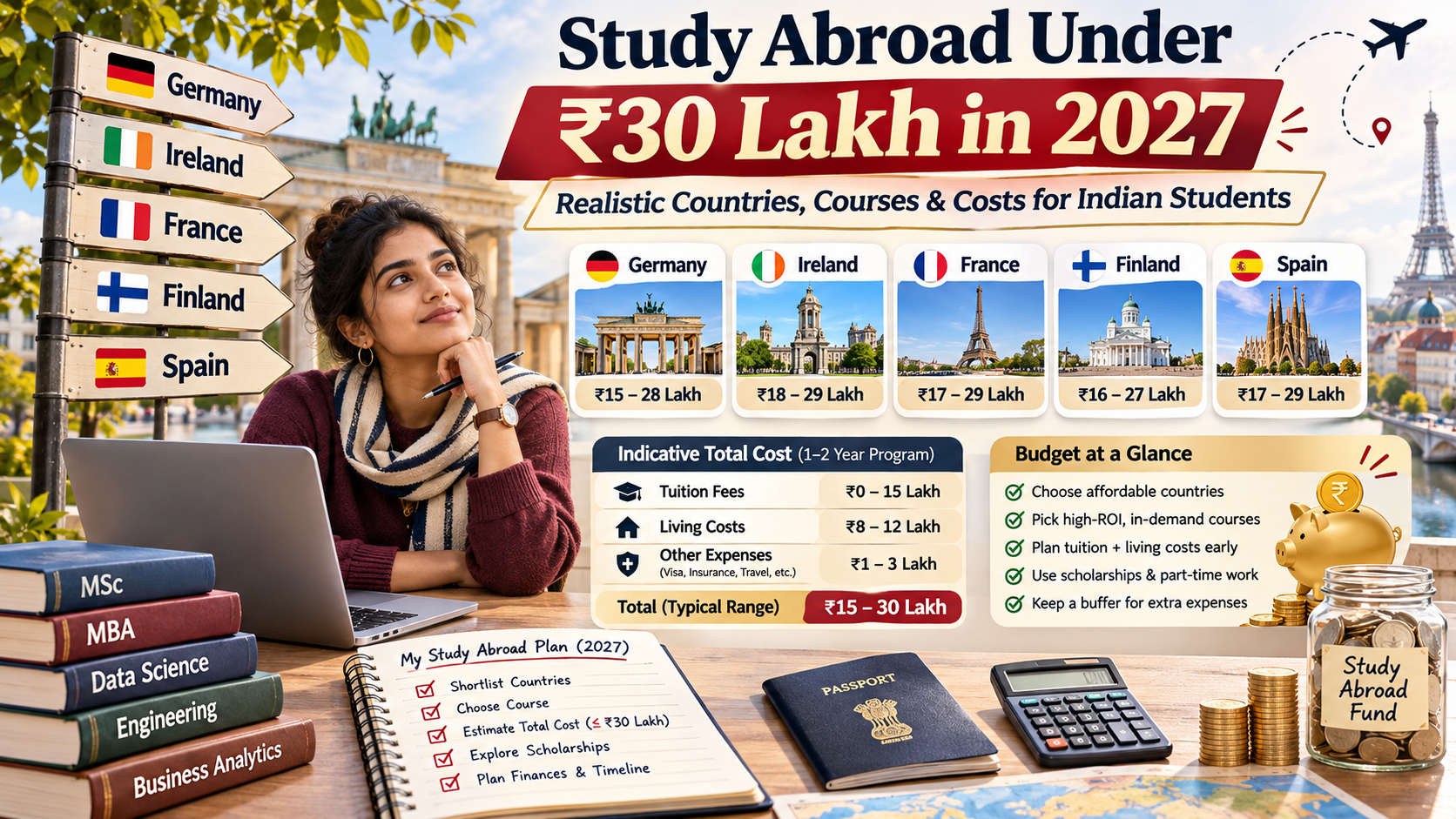
Public universities in Germany charge zero tuition fees for most master’s programs, requiring only a nominal semester contribution of €150 to €350. This means your ₹30 lakh budget is almost entirely preserved for your own living expenses.
To secure a German student visa in 2027, you must deposit €11,904 (roughly ₹10.7 lakhs) into a blocked account. Even factoring in flights, health insurance, and the mandatory APS Certificate processing fees, you can easily complete a two-year master’s degree in Germany well under ₹20 lakhs. The primary trade-off is the strict requirement to learn the German language to secure a corporate job post-graduation.
Ireland: Making It Work Under ₹30 Lakh
Ireland is highly attractive because it offers a native English-speaking environment, a booming tech/pharma sector, and a 24-month Stamp 1G post-study work visa.
Can you study in Ireland under ₹30 lakh? Yes, but it requires tight financial discipline. Irish Master’s programs are typically one year long. If you target a regional university or a specialized institute of technology, tuition hovers around €14,000 to €16,000 (₹12.5L – ₹14.3L). The Irish government requires you to show €10,000 (₹9L) in living funds for the visa.
Combined with flights and insurance, your upfront cost sits around ₹24 lakhs. However, Ireland is facing a severe housing crisis. Rent in Dublin is exorbitant, meaning you must target universities in cities like Cork, Limerick, or Galway to keep your living costs strictly within budget.
France, Finland, Spain & Other European Options
Mainland Europe offers some of the most affordable countries to study abroad in 2027 without compromising on STEM and business career outcomes.
France: The government heavily subsidizes public university tuition for international students, capping Master’s degrees at €3,770 (₹3.3L) per year. Coupled with the government-backed student housing subsidy (CAF), France is a high-ROI destination for tech and aerospace students.
Finland & Spain: These countries offer excellent specialized master’s programs in AI, data science, and renewable energy. Tuition ranges from €8,000 to €12,000, keeping total first-year expenses well below the ₹25 lakh mark.
The Reality Check: UK, USA, Canada & Australia
If your budget is strictly capped at ₹30 lakh, traditional destinations require severe compromises.
United Kingdom: You can find 1-year master’s programs at regional UK universities for £15,000 to £17,000. While this fits the budget, you must factor in the shrinking 18-month Graduate visa and high NHS surcharges.
Canada: With the new mandatory CAD 20,635 (₹12.6L) Guaranteed Investment Certificate (GIC) for living expenses, plus skyrocketing international tuition, completing a degree in Canada under ₹30 lakh is now mathematically difficult unless you secure substantial entrance scholarships.
USA & Australia: Pursuing masters abroad under 30 lakhs in these two countries is largely unrealistic for 2027 without a fully funded scholarship or graduate assistantship. The AUD 29,710 living fund requirement in Australia and massive US tuition fees push these destinations into the ₹40L+ tier.
₹20L vs ₹25L vs ₹30L: How Your Options Change
Budget Tier
Viable Countries
Strategic Approach
₹15L – ₹20L
Germany, Italy, France (Public)
Focus entirely on zero/low-tuition public universities. Budget covers blocked accounts, flights, and living.
₹21L – ₹25L
Spain, Finland, Regional UK
Opens up affordable English-taught programs in Western Europe and tier-2 UK cities.
₹26L – ₹30L
Ireland, Affordable Canadian/UK
Unlocks English-speaking tech hubs, provided you secure housing early and avoid expensive capital cities.
Hidden Costs Students Usually Forget
When planning your study abroad cost 2027, failure to account for hidden expenditures will ruin your budget.
Forex Markups: Indian banks charge high markup fees and TCS (Tax Collected at Source) on large international tuition transfers.
Housing Deposits: Securing an apartment abroad usually requires the first month’s rent plus a security deposit equivalent to one or two months of rent upfront.
Immigration Health Surcharges: Countries like the UK charge massive upfront healthcare fees covering the entire duration of your visa before you even fly.
Scholarship and Education Loan Strategy
To protect your liquid savings, you must approach funding strategically.
Do not rely on the promise of part-time jobs to pay your tuition; part-time income is strictly for weekly groceries and rent. Instead, target specific university merit scholarships early. Furthermore, structure your education loan through recognized public banks (like SBI) that offer lower interest rates via collateral, rather than falling into the trap of high-interest unsecured loans pushed by commission agents.
At Aara Education Consultancy, we support comprehensive education-loan planning and strict financial auditing, ensuring your funding trail easily passes the intense scrutiny of consular visa officers.
The Final Decision Framework
To find the best country for Indian students under 30 lakhs, you must evaluate your profile systematically. Do not start by picking a country on a map.
Start with your Budget. Match it to a Course that has a structural labor shortage. Select the Country that offers that course within your financial limit. Evaluate the Career Outcomes, audit the strict Visa requirements, and calculate the final ROI.
Navigating this financial maze requires precision. We do not push students toward expensive universities just to secure a commission. We audit your exact financial capacity and academic profile to build a bulletproof, budget-compliant visa strategy.
If you want to ensure your 2027 study abroad plan is mathematically sound and perfectly aligned with your career goals, click the WhatsApp button below and contact Aara Education Consultancy today.
Frequently Asked Questions (FAQs)
Is it possible to study in the UK or Canada under ₹30 lakh in 2027?
It is mathematically difficult but possible if you make strict compromises. In Canada, the new CAD 20,635 GIC requirement consumes nearly ₹12.6 lakhs upfront, leaving a very tight margin for tuition. In the UK, you must target regional universities with 1-year Master’s programs and avoid expensive hubs like London.
Does a ₹30 lakh study abroad budget include living expenses?
Yes, it absolutely must. A compliant visa budget includes your tuition fees, mandatory government living funds (like the German Blocked Account or Canadian GIC), health insurance, flights, and visa application fees. Never allocate your entire ₹30 lakh solely to university tuition.
Which country offers the best ROI for Indian students under 30 lakhs?
Germany currently offers the highest financial ROI. Because public universities charge zero tuition fees, your budget is used entirely to cover your own living expenses via the €11,904 blocked account. Ireland is the best English-speaking alternative, provided you secure affordable housing outside of Dublin.
Can I rely on part-time jobs to fund my tuition if I am on a strict budget?
No. Consular officers will reject your student visa if your financial trail relies on projected part-time income. You must prove you have the liquid funds or an approved education loan to cover your first full year of tuition and living expenses before you even land. Part-time work is strictly for managing weekly groceries and personal expenses.
We provide 360° Solution for your Education Needs. Contact us