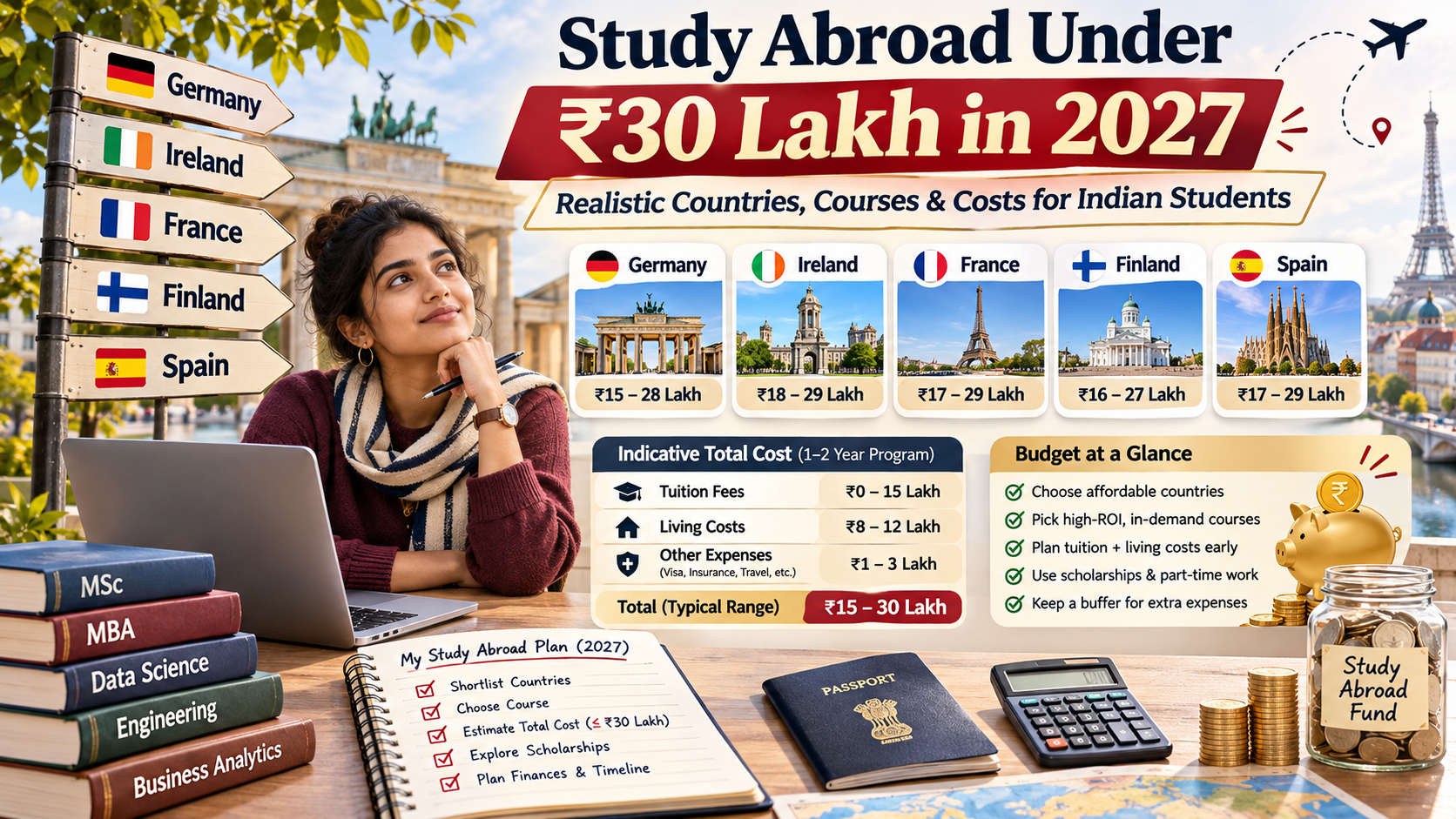
Study Abroad Proof of Funds 2027: Exact Bank Rules & Visa Traps
Quick Answer: Meeting study abroad proof of funds 2027 rules requires more than showing a high bank balance. Major destinations have raised financial thresholds—including the UK’s November 30, 2026 hike (£14,130 in London) and Canada’s CAD 23,448 requirement. To avoid an instant refusal, you must season your funds early, prove their legal origin, and maintain a 10–15% currency buffer.
Having enough money in your bank account is no longer enough to get a student visa. Today, one sudden lump-sum deposit can ruin your application. Similarly, a single-day balance dip during the 28-day holding window or a sudden rupee drop on filing day can trigger an automatic refusal.
For Indian students and parents preparing for January or Fall 2027 intakes, understanding study abroad proof of funds 2027 is critical. Immigration officers no longer just glance at your final closing balance. Instead, they audit your transaction history, verify the legal source of every rupee, and check your sponsor’s tax records.
If you rely on outdated agent advice, you risk losing non-refundable visa fees and missing your intake completely. Here is the exact, country-by-country compliance guide to protect your 2027 application.
Why Consulates Are Auditing Indian Bank Statements in 2027
In the past, some local agents suggested borrowing short-term cash from relatives to inflate a bank balance temporarily. However, consulates have cracked down hard on these “show money” tactics.
Today, immigration systems run automated and manual compliance checks across multiple financial documents. Consequently, officers examine three strict criteria before approving your visa:
Seasoning Period: Your money must sit untouched in an approved account for a fixed duration, typically 28 days to 6 months.
Traceable Source: Officers expect clear proof of where the money originated, such as salary slips, business income, property sales, or tax returns.
Immediate Liquidity: Your funds must be instantly accessible in cash or a valid education loan, rather than locked inside illiquid assets.
Therefore, treating your financial file like a formal corporate audit is the safest way to secure your visa.
The UK 30 November 2026 Hike & The 28-Day Rule
The United Kingdom has introduced a major financial update under Statement of Changes HC 584. Starting November 30, 2026, UK Visas and Immigration (UKVI) is increasing the mandatory living-cost maintenance requirements for all new Student visa applications.
Specifically, the updated UK maintenance rates for up to nine months of study are:
Inside London: Increases from £1,529 to £1,570 per month (up to £14,130 for 9 months).
Outside London: Increases from £1,171 to £1,203 per month (up to £10,827 for 9 months).
Accommodation Offset Cap: Increases to £1,570 for qualifying university-arranged housing deposits.
Importantly, these new rates apply strictly based on your online visa submission date, not your CAS issue date or course start date. Even if you received your CAS in October 2026, applying on or after November 30, 2026 means you must show the higher balance.
Moreover, you must follow UKVI’s rigid timing rules without a single slip:
Hold your unpaid first-year tuition plus maintenance funds for 28 consecutive days.
Never let the account dip below the required pound amount—not even by ₹500 for one single day—or your 28-day clock resets to zero.
Ensure your bank statement’s closing date falls within 31 days of your online visa application.
Remember that UKVI converts INR balances using the OANDA spot exchange rate on the exact day you apply.
Because exchange rates fluctuate daily, a borderline rupee balance can fall short overnight. Always maintain an extra 10% to 15% buffer above the exact OANDA conversion.
Canada, Australia & USA: New Study Abroad Proof of Funds 2027 Rules
Beyond the UK, other top English-speaking destinations have tightened their study abroad proof of funds 2027 policies. Understanding each country’s specific audit triggers will save you from costly rejections.
Canada: CAD 23,448 & The 6-Month Source Check
For applications submitted on or after September 1, 2026, Immigration, Refugees and Citizenship Canada (IRCC) raised the minimum living-cost requirement outside Quebec to CAD 23,448 for a single student. You must show this amount on top of your first-year tuition fees and travel costs.
Additionally, following IRCC’s July 2026 officer guidelines, visa officers now strictly inspect 6 months of bank statements alongside documented proof of income. Although a Canadian Guaranteed Investment Certificate (GIC) is not legally mandatory, purchasing a GIC from a recognized bank remains one of the cleanest, most verifiable ways to prove your living funds. Furthermore, if your degree lasts two years, you must also explain how you will fund the second year through parental income or multi-year scholarships.
Australia: AUD 29,710 & Genuine Student Audits
Australia requires primary student visa applicants to prove AUD 29,710 for annual living expenses, plus first-year tuition fees and return airfare. Alternatively, families can meet the financial threshold by proving an official annual income of AUD 87,856 for a single student (or AUD 102,500 with accompanying family members).
Because Australia pairs financial checks with its strict Genuine Student (GS) assessment, inconsistent savings or unverified deposits raise instant red flags. Every rupee shown must align cleanly with your sponsor’s filed Income Tax Returns (ITRs).
USA: I-20 Liquid Funds & Hidden Visa Fees
Unlike the UK or Canada, the US does not enforce a fixed national 28-day bank rule. Instead, you must prove readily available liquid funds covering the exact first-year total printed on your Form I-20, plus a realistic funding plan for remaining years.
During your F-1 visa interview, consular officers look for absolute consistency. Your sponsor’s stated occupation and annual income must logically match the savings shown on your DS-160 and financial certificates.
In addition, budget separately for federal visa fees. Right now, Indian F-1 applicants pay $535 upfront ($350 SEVIS I-901 fee plus $185 MRV application fee). However, 2025 US legislation also created a $250 Visa Integrity Fee payable at visa issuance. While Indian consulates were not actively collecting this $250 charge as of late 2026, it remains written into US law. Therefore, keeping an extra ₹25,000 in reserve ensures you are ready if collection switches on before your 2027 interview.
European hubs offer more affordable budgets, yet their verification rules remain unforgiving.
Germany: For both 2026 and 2027, you must deposit €11,904 (€992 per month) into an official German Blocked Account (Sperrkonto) strictly in your own name. Most public universities charge zero tuition, making this blocked amount your primary financial requirement.
Ireland: For degree courses lasting over eight months, you must prove immediate access to €10,000 for living expenses alongside your tuition fees. You must submit 6 months of bank statements on official bank letterhead showing clear, regular transaction activity.
Study Abroad Proof of Funds 2027: Country Comparison Table
Use this quick reference table to benchmark your 2027 visa requirements accurately across major destinations.
Country
Mandatory Living Funds (2027)
Plus Tuition?
Key Bank / Compliance Rule
UK (From 30 Nov 2026)
£14,130 (London) / £10,827 (Outside)
Yes (unpaid CAS fees)
28 consecutive days; statement within 31 days; OANDA rate
Canada (Outside Quebec)
CAD 23,448 (Single applicant)
Yes (Year 1 + travel)
6-month bank history + source of funds; GIC strongly recommended
Australia
AUD 29,710 (or AUD 87,856 income)
Yes (Year 1 + travel)
Strict verifiable source of funds + Genuine Student check
USA
Exact Year 1 total on Form I-20
Included in I-20
Liquid funds + matching sponsor income + $535–$785 visa fees
Germany
€11,904 (€992/month)
Mostly €0 (public)
Official Blocked Account (Sperrkonto) in student’s own name
Ireland
€10,000 (Courses > 8 months)
Yes (Year 1 tuition)
6-month bank statement on headed paper + immediate access
5 Bank Statement Red Flags That Trigger Instant Visa Refusals
Even wealthy families lose visas over avoidable paperwork mistakes. Watch out for these five compliance traps:
Unexplained Lump-Sum Deposits: Transferring ₹15 Lakhs into an account right before filing looks like borrowed money. Always document large deposits with sale deeds, FD maturity proofs, or business invoices.
Using Unapproved Banks: Consulates reject statements from unregistered cooperative banks or non-regulated local credit societies. Stick strictly to major nationalized or RBI-regulated private banks.
Zero Currency Buffer: Showing the exact minimum amount in INR leaves no safety margin. If the rupee weakens by 2% before your visa date, your file drops below the legal minimum automatically.
Missing Sponsor Relationship Proof: Using a parent’s bank account without submitting your official birth certificate and a signed parental consent letter triggers immediate document refusals.
Submitting Illiquid Assets: Credit cards, gold valuations, agricultural land deeds, or volatile stock portfolios do not count as primary liquid proof of funds for most student visas.
Education Loans vs. Liquid Savings: Structuring an Airtight Trail
You do not need to drain all your family savings to satisfy study abroad proof of funds 2027 rules. In fact, an approved education loan from a regulated bank often creates a stronger compliance trail than scattered savings accounts.
For example, UKVI accepts official student loan sanction letters without requiring the 28-day cash holding period. However, the loan letter must meet strict legal standards:
It must be issued by a recognized, regulated bank or official educational loan scheme.
It must be dated no more than 6 months before your visa application date.
It must clearly state your name, exact sanctioned amount, and confirm the funds will release before your course starts with no extra conditions other than your study approval.
At Aara Education Consultancy, we do not just review your university admissions. We also guide your education-loan structuring and audit your sanction letters against embassy rules before you pay non-refundable visa fees.
Step-by-Step: The Aara 4-Step Financial Audit Checklist
Follow this disciplined sequence at least three months before your target visa date to keep your file bulletproof.
Step 1: Calculate Your Exact Foreign Currency Total. Add your unpaid first-year tuition, mandatory living funds, health surcharges, and upfront visa fees in the destination’s currency.
Step 2: Add a 10% to 15% Rupee Buffer. Convert your total into INR and immediately add a 10–15% margin. This buffer protects you from daily exchange rate swings and bank transfer charges.
Step 3: Season Funds Early and Consolidate. Move your liquid savings into one or two primary accounts well ahead of the 28-day (UK) or 6-month (Canada/Ireland) window. Keep the balance completely untouched.
Step 4: Audit Every Supporting Paper Before Filing. Match your bank statements, loan sanction letters, birth certificate, sponsor consent letter, and ITRs line by line. Never submit a single PDF without checking dates, spellings, and account numbers.
Final Answer
Securing a student visa in 2027 is no longer just about getting an offer letter—it is a strict financial compliance test. With rising living-cost minimums across the UK and Canada and tougher source-of-funds audits worldwide, guesswork can cost you both your intake and your family’s savings. Planning your study abroad proof of funds 2027 early, keeping a healthy currency buffer, and documenting every rupee transparently is the only safe path forward.
At Aara Education Consultancy, we operate as your dedicated compliance auditors. With zero university tie-ups and 360° guidance—from unbiased university shortlisting to education-loan planning and pre-filing bank statement audits—we verify every figure in your financial file before it ever reaches an embassy officer.
Do not risk a visa refusal over a preventable bank statement mistake. Click the WhatsApp button below and contact Aara Education Consultancy today to book your complete 2027 financial and profile audit.
Frequently Asked Questions (FAQs)
Does the 30 November 2026 UK funds hike apply if I already have my CAS?
Yes. UKVI decides your required maintenance amount strictly by the date you submit your online visa application, not your CAS issue date. If you apply on or after November 30, 2026, you must show £1,570 per month in London or £1,203 per month outside London.
Can I use my parents’ savings account or Fixed Deposit for study abroad proof of funds 2027?
Yes, most countries—including the UK, Canada, Australia, the USA, and Ireland—allow parental savings or liquid Fixed Deposits. However, you must attach your birth certificate, a signed letter of financial support, and proof of your parents’ income. Note that Germany requires the Blocked Account strictly in the student’s own name.
Does an education loan sanction letter bypass the UK 28-day rule?
Yes. If you fund your UK tuition and living costs through an eligible, regulated education loan, you do not need to hold cash for 28 days. Your official loan letter simply needs to be dated within 6 months of applying and carry no release conditions other than your university admission.
How much forex buffer should Indian students keep in their bank accounts?
Keep an extra 10% to 15% buffer above the minimum required INR amount. Embassies convert your balance on the day of application—such as UKVI using the daily OANDA spot rate—so a small buffer prevents sudden currency dips from causing an avoidable rejection.
We provide 360° Solution for your Education Needs. Contact us