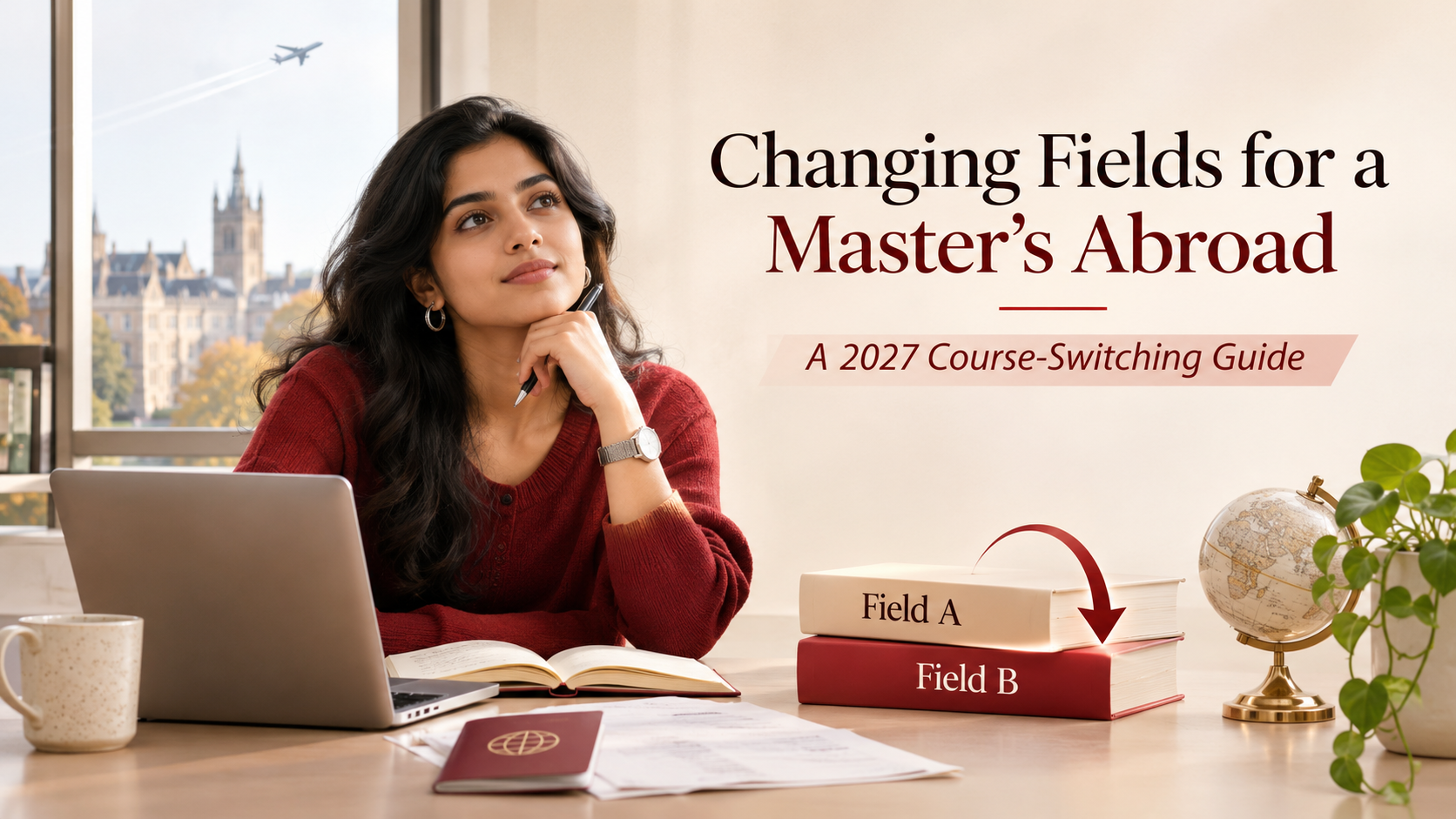
Can You Change Your Field for a Master’s Abroad in 2027? A Course-Switching Guide
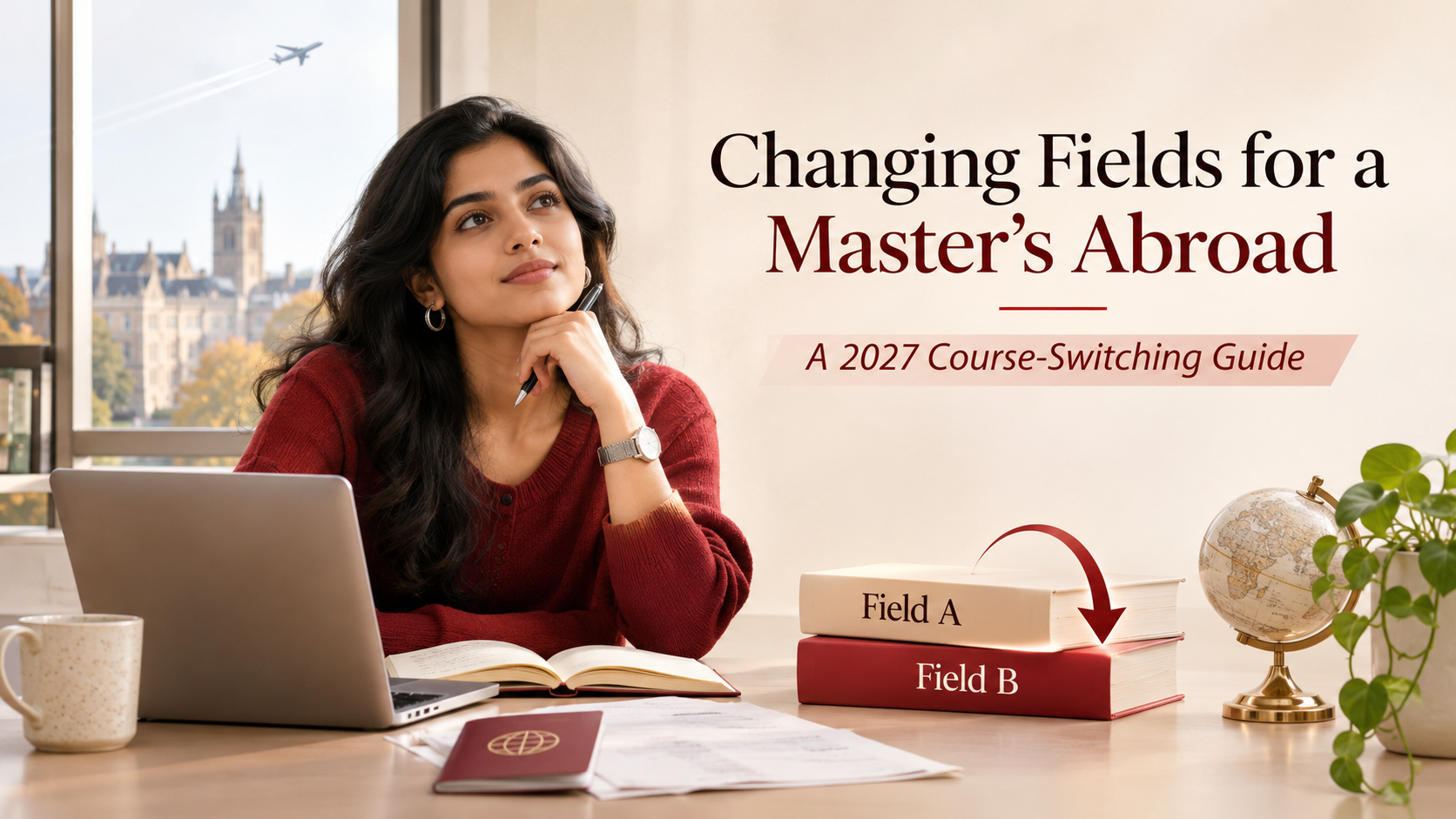
Yes, an Indian student can change field for masters abroad in 2027, provided their chosen programme accepts applicants from diverse undergraduate backgrounds. While many international universities offer conversion or interdisciplinary master’s degrees, others require specific undergraduate subjects, quantitative credits, or relevant work experience. Eligibility depends on the individual university and department rather than a single country-wide rule.
For many Indian students and parents, choosing a bachelor’s degree at age seventeen or eighteen happens before a clear career direction has formed. A BCom graduate may discover a strong interest in data analytics, an engineering graduate may decide to move into finance, or a BA graduate may want to transition into computing or human resource management.
The encouraging news is that international postgraduate systems are often more flexible than traditional Indian postgraduate admissions, where changing streams can be restricted. However, flexibility does not mean open entry to every course. Knowing where course switching works—and where strict academic prerequisites apply—will save you from wasted application fees and avoidable rejections.
Can You Pursue a Master’s in a Different Field Abroad?
Postgraduate admissions committees abroad do not assess applications through a single rigid rule. Instead, universities group their master’s degrees into four broad eligibility models, and understanding which category your target course belongs to is the first step in planning an academic transition.
Multi-disciplinary programmes open to any background: Certain postgraduate degrees are designed for graduates from any recognised discipline. Common examples include Master’s in Management (MiM), International Business, Marketing, Public Policy, and selected entrepreneurship or media programmes. Here, universities care more about your overall academic record, analytical aptitude, and motivation than your undergraduate subject title.
Conversion master’s programmes: Primarily offered in the United Kingdom and Ireland, conversion courses are built specifically for students who want to enter a new discipline—such as Computer Science, Psychology, Law, or Data Science—without having studied it at undergraduate level. These courses compress foundational undergraduate concepts into the first term before moving to advanced postgraduate modules.
Subject-restricted and credit-based programmes: Many technical, scientific, and quantitative degrees require applicants to have completed specific undergraduate subjects or academic credits. For example, public universities in Germany frequently assess applications using European Credit Transfer and Accumulation System (ECTS) equivalents, requiring a set number of credits in mathematics, statistics, or core engineering subjects before granting admission.
Professionally regulated or accredited programmes: Fields tied to statutory licensing—such as clinical psychology, medicine, nursing, architecture, chartered accountancy, or accredited civil and mechanical engineering—carry strict regulatory prerequisites. Changing into these fields usually requires completing an accredited undergraduate qualification or a formal multi-year bridging route.
Above all, remember the difference between meeting minimum eligibility criteria and securing an offer. Being eligible to apply simply means your application will be reviewed; competitive programmes still select candidates who demonstrate clear preparation and strong academic performance.
Which Master’s Degrees Allow Students to Change Their Field?
Different undergraduate backgrounds open different postgraduate doors. The table below outlines common cross-disciplinary pathways Indian students explore for 2027, alongside the conditions universities typically attach to them.
| Undergraduate Background | Potential Master’s Direction | Typical Prerequisites or Conditions | What the Student Should Verify |
| BCom | Business Analytics, Finance, Management, FinTech | Quantitative aptitude; basic statistics or accounting credits; strong academic grades | Whether the course requires calculus, econometrics, or programming foundations |
| BBA | Marketing, Supply Chain Management, International Business, Business Analytics | Recognised bachelor’s degree; analytical or quantitative modules for analytics tracks | Whether work experience is preferred or if the course is designed for recent graduates |
| BA (Humanities / Social Sciences) | Human Resource Management, Public Policy, Media, International Relations | Relevant essay-based or analytical coursework; strong Statement of Purpose | Whether quantitative policy or economics tracks require prior statistics credits |
| BA (Non-Computing) | Computer Science (Conversion) or Information Systems | Strong overall grades; evidence of logical or mathematical aptitude (such as Class 12 maths) | That the programme explicitly accepts non-computing graduates rather than CS majors |
| BSc (Mathematics, Statistics, Physics) | Data Science, Quantitative Finance, Actuarial Science, AI | Linear algebra, calculus, probability, and introductory programming skills | Specific coding languages required (such as Python or R) prior to enrolment |
| BTech / BE (Engineering) | Finance, Management, Supply Chain, Product Management, Data Analytics | Strong quantitative foundation; clear rationale for moving from engineering to business | Whether GMAT/GRE scores or post-graduation work experience are recommended |
| BSc Life Sciences / Pharmacy / BDS | Public Health (MPH), Healthcare Management, Clinical Research | Health, biology, or quantitative coursework; healthcare internships strengthen profiles | Whether clinical work experience is mandatory or optional for entry |
Treat these pathways as realistic starting points rather than automatic guarantees. When switching into quantitative or technical fields, universities routinely examine your semester transcripts for mathematics, statistics, or programming coursework, and certain health or business tracks may ask for relevant internships or professional qualifications.
Conversion Master’s vs Specialised Master’s Degrees
Confusing a conversion master’s with a specialised master’s is one of the most common reasons students receive early admissions rejections. Although both lead to a master’s qualification, their curriculum design and entry expectations are completely different.
A conversion master’s is structured for career changers and graduates from unrelated disciplines. Because students enter without prior subject training, the university dedicates the early weeks of the degree to intensive foundational teaching—covering core theory, technical tools, and discipline-specific methods from the ground up. These programmes are widely established in the UK and Ireland, particularly in computing, data analytics, management, and psychology.
By contrast, a specialised master’s assumes you already possess a solid undergraduate grounding in that subject. Lectures begin at an advanced level immediately, leaving no room to teach introductory concepts. Applying to a specialised MSc in Artificial Intelligence or Financial Engineering without the required undergraduate mathematics and coding credits almost always results in rejection, regardless of how strong your overall grades are.
Professional accreditation also shapes eligibility. In the UK, for instance, certain conversion programmes carry accreditation from professional bodies such as BCS (The Chartered Institute for IT) or the British Psychological Society (BPS), allowing career changers to meet industry standards without repeating a three-year bachelor’s degree. Never rely on a course title alone; always read the detailed entry requirements and module list to see whether a degree is built for beginners or specialists.
Can Commerce, Arts and Science Students Switch to Technology?
Moving from a non-computing background into technology is one of the most frequent enquiries among Indian students planning for 2027. The answer depends entirely on which technology discipline you choose and how technical the curriculum is.
Business Analytics and Data Analytics: These are generally the most accessible technology pathways for BCom, BBA, economics, and non-CS engineering graduates. Most programmes focus on applying statistical tools, SQL, visualisation platforms, and business modelling to commercial decisions, rather than building software architecture from scratch.
Computer Science (Conversion Tracks): Commerce, arts, and science graduates can enter computer science through dedicated conversion master’s programmes. These courses typically require strong overall undergraduate grades and evidence of numerical or logical reasoning, rather than a prior computing degree.
Data Science and Artificial Intelligence: Pure MSc Data Science and MSc Artificial Intelligence programmes are far more selective. While BSc graduates in mathematics, statistics, or physics often qualify directly, BCom or BA graduates without substantial linear algebra, calculus, probability, and programming credits will struggle to meet entry requirements for rigorous technical tracks.
Cybersecurity: Entry rules in cybersecurity vary widely. Technical network-security and cryptography programmes usually expect an IT, computer science, or electronics background, whereas governance, risk, and information security management tracks are sometimes open to broader graduates with relevant analytical or IT exposure.
One crucial reality check: completing a short self-paced online certificate in Python or data analytics shows genuine interest, yet it rarely replaces formal university-level academic credits in mathematics or computer science when admissions committees audit transcripts.
University Eligibility Examples — What Students Should Actually Check
Because rules differ sharply even within the same country, comparing actual university requirements reveals what admissions teams truly look for. The table below presents four illustrative examples across different eligibility models, verified against official university programme pages on 25 November 2026.
| University and Programme | Accepted Academic Background | Important Prerequisites | Official Programme Link |
| University College London (UCL) — MSc Computer Science | Graduates from disciplines other than computer science or information technology (minimum upper second-class UK degree or Indian equivalent). | Explicitly excludes CS/IT graduates; requires evidence of suitable mathematical and analytical aptitude. | https://www.ucl.ac.uk/prospective-students/graduate/taught-degrees/computer-science-msc |
| University of Birmingham — MSc Computer Science | Graduates from any non-computing discipline holding a 2:1 Honours degree or recognised Indian equivalent. | Designed as a conversion programme; no prior programming experience is required, though strong academic grades are essential. | https://www.birmingham.ac.uk/study/postgraduate/taught/computer-science/computer-science |
| University of Warwick (WBS) — MSc Business Analytics | Open to graduates from a wide range of quantitative and non-quantitative backgrounds with a 2:1 UK degree or Indian equivalent. | Requires strong numerical and analytical capability alongside clear interest in data-driven business decisions. | https://www.wbs.ac.uk/courses/postgraduate/business-analytics/ |
| Technical University of Munich (TUM) — MSc Data Engineering and Analytics | Specialised technical degree requiring a bachelor’s in computer science, mathematics, or a closely related field. | Strict subject-specific credit evaluation in mathematics, statistics, and computer science; non-technical degrees do not qualify directly. | https://www.tum.de/en/studies/degree-programs/detail/data-engineering-and-analytics-master-of-science-msc |
Disclaimer: These examples reflect the latest published admission criteria verified on 25 November 2026. Universities update intake rules periodically, so students applying for 2027 must reconfirm exact eligibility, Indian grade equivalencies, and deadlines directly on each official programme page before submitting an application.
Notice the sharp contrast across these four programmes. Both UCL and the University of Birmingham welcome non-computing graduates into computer science, whereas TUM enforces strict technical credit matching for data engineering, and Warwick bridges business and analytics for broader graduates. Always evaluate eligibility at the individual programme level rather than assuming an entire country follows one rule.
Can Work Experience Help You Change Your Academic Field?
Relevant work experience can add genuine weight to a course-switching application, particularly when you are moving into management, business analytics, marketing, human resources, or information systems. Full-time employment, structured internships, industry projects, and documented portfolio work demonstrate that your interest in the new field is tested rather than impulsive.
For instance, a mechanical engineer who has spent two years working as a business analyst at a consulting firm can use that experience to present a compelling case for an MSc in Business Analytics or Finance. Similarly, a BA graduate with two years in talent acquisition brings credible context to an MSc in Human Resource Management.
However, practical experience has clear boundaries. In credit-driven and technical programmes—especially in Germany, Canada, and selective US engineering departments—work experience rarely replaces missing undergraduate academic credits in calculus, algorithms, or laboratory sciences. When formal academic prerequisites are missing, completing accredited university-level prerequisite modules, a recognised postgraduate diploma, or an approved foundation or pre-master’s pathway is usually the only reliable way to bridge the gap.
How to Build a Strong Profile Before Switching Fields
If you are planning to change field for masters abroad in 2027, starting six to twelve months ahead of application deadlines gives you time to close eligibility gaps properly.
Audit your undergraduate transcript: List every subject you studied across all semesters, paying special attention to mathematics, statistics, economics, research methods, and computing modules. Admissions officers assess actual subjects taken, not just your final degree title.
Identify missing academic prerequisites: Compare your transcript against the entry requirements of five to eight target programmes. Note whether universities ask for specific credits, minimum quantitative grades, or accredited coursework.
Explore relevant foundational courses: Where prerequisites are missing, look into credit-bearing university bridge modules, recognised post-baccalaureate courses, or structured quantitative preparation rather than relying solely on informal videos.
Complete a meaningful project or internship: Gain practical exposure in your target field through an internship, research assistantship, or documented analytical project that shows you can handle the work involved.
Prepare a credible explanation of your academic transition: Your Statement of Purpose should connect your past studies to your future goals logically, showing how your existing skills complement the new discipline. Remember that a persuasive SOP supports an eligible application, but it cannot override strict academic credit rules if you fail the university’s formal entry criteria.
Shortlist universities using exact programme-level requirements: Build a balanced list of conversion, interdisciplinary, and realistic target programmes where your qualifications genuinely match published entry rules.
A Practical Course-Switching Eligibility Checklist
Before paying application fees or booking standardised tests, save and review this checklist to separate mandatory admission requirements from profile-strengthening advantages.
Formal Admission Requirements (Mandatory Gatekeepers)
Undergraduate degree compatibility: Confirm whether the programme explicitly welcomes all disciplines, accepts conversion applicants, or restricts entry to specific subjects.
Required subject knowledge and credits: Verify that your transcript covers any mandatory modules in mathematics, statistics, programming, or core sciences.
Academic grades and equivalency: Check how the university converts your Indian CGPA or percentage into its local grading benchmark (such as a UK 2:1 or US 3.0 GPA equivalent).
Language proficiency requirements: Confirm required IELTS, TOEFL, or PTE scores and check whether individual band minimums apply.
Professional accreditation rules: If your target career requires statutory licensing, check whether the master’s degree is accredited by the relevant professional body.
Profile-Strengthening and Decision Factors (Competitive Edge)
Relevant professional experience: Document any internships, full-time roles, or freelance work connected to your new field.
Evidence of preparation for the new field: Include technical projects, quantitative test scores (GMAT or GRE where helpful), or structured foundational coursework.
Tuition fees and financial feasibility: Calculate total tuition, living costs, currency buffers, and funding options before committing to a course.
Career opportunities after graduation: Research realistic entry-level roles, employer demand, and post-study work visa conditions in your destination country.
Common Mistakes Students Make When Changing Their Field
Avoiding predictable missteps is just as important as building a strong application.
Choosing a course solely because it is trending: Enrolling in artificial intelligence or data science simply because of social media headlines often leads to academic struggle if you dislike coding or advanced statistics.
Confusing admission eligibility with career suitability: Being accepted onto a conversion course does not automatically make the day-to-day work enjoyable or suited to your strengths.
Ignoring mathematics or programming prerequisites: Overlooking quantitative requirements is one of the fastest ways to receive an automated rejection from technical programmes.
Applying based only on university rankings: A lower-ranked university offering a well-structured conversion programme with strong industry links is far better than an automatic rejection from a famous institution that does not accept career changers.
Assuming short certificates replace academic credits: Weekend bootcamps and short online certificates demonstrate curiosity, yet universities rarely treat them as equivalent to semester-long undergraduate credits.
Ignoring professional licensing requirements: Switching into fields such as clinical psychology, architecture, or healthcare without checking home-country and destination licensing laws can limit where you are allowed to practise after graduation.
Failing to explain the academic transition convincingly: Submitting a generic Statement of Purpose that ignores why you are leaving your undergraduate subject leaves admissions officers questioning your commitment.
Should You Change Your Field for a Master’s Abroad?
Changing your academic direction for a master’s degree abroad is a major academic and financial decision, and it is not always the right move for everyone.
Switching fields makes sense when you have a clear, well-researched reason for the transition, meet the programme’s genuine academic requirements, have tested your interest through practical exposure, and understand the entry-level job market you will enter after graduation. In these cases, a well-chosen conversion or interdisciplinary master’s can open rewarding global career paths.
Conversely, staying within your core discipline—or pursuing a hybrid specialisation that builds directly on your bachelor’s degree—may be wiser if you are changing fields purely out of peer pressure, lack required quantitative foundations without time to build them, or would take on heavy debt for an uncertain career pivot. Taking extra time to gain relevant Indian work experience or complete prerequisite coursework before applying is often far safer than rushing into an unsuitable programme.
Frequently Asked Questions
1. Can I pursue a master’s abroad in a different field from my bachelor’s?
Yes, many universities abroad allow Indian students to pursue a master’s in a different discipline through open-entry programmes (such as Management or Marketing) or structured conversion courses (such as Computer Science or Data Analytics). Eligibility depends on the specific university, your undergraduate grades, and whether the programme requires prior subject credits.
2. Can a BCom graduate pursue a master’s in Computer Science abroad?
A BCom graduate cannot usually enter a traditional, specialised MSc in Computer Science that requires prior computing credits. However, BCom graduates with strong overall grades and quantitative aptitude can apply to dedicated Computer Science conversion programmes—offered mainly in the UK and Ireland—that teach computing fundamentals from the beginning.
3. Can a BA graduate pursue Data Science?
Yes, depending on the programme structure. While highly technical Data Science degrees require undergraduate calculus, linear algebra, and programming, several universities offer applied Data Science or Data Analytics conversion programmes open to humanities and social science graduates who demonstrate strong analytical and numerical capability.
4. Do I need work experience to change my field?
Work experience is not mandatory for most conversion or entry-level interdisciplinary master’s programmes, which regularly admit fresh Indian graduates. However, relevant internships or full-time work experience can significantly strengthen your application—especially for business, management, or analytics programmes—and help explain your motivation for switching fields.
5. What is a conversion master’s degree?
A conversion master’s is an intensive postgraduate degree designed for graduates whose bachelor’s degree is in an unrelated subject. Common in the UK and Ireland, it covers essential foundational concepts in the new discipline during the first semester before advancing to postgraduate-level modules and a final dissertation or project.
6. Can online certifications help me meet admission requirements?
Online certifications show genuine motivation and basic familiarity with a new field, which can support your Statement of Purpose. However, short non-credit certificates rarely substitute for formal undergraduate academic credits when universities enforce strict mathematics, statistics, or engineering prerequisites.
7. Is it difficult to get a student visa after changing academic fields?
Changing academic fields does not automatically lead to a visa refusal, provided your academic progression is logical, transparent, and supported by genuine financial documentation. Immigration authorities—such as UK Visas and Immigration (UKVI), Immigration, Refugees and Citizenship Canada (IRCC), the U.S. Department of State, and the Australian Department of Home Affairs—assess whether applicants are genuine students with credible study plans, so explaining your transition clearly is essential.
8. How can I check whether I qualify for a particular master’s programme?
Start by reviewing the official university programme page under its entry requirements and international qualifications sections. Compare your semester transcripts against required subjects and grade equivalencies, check whether work experience or tests like the GMAT or GRE are needed, and contact the university admissions team or a qualified counsellor before paying application fees.
How Aara Education Consultancy Can Help
Evaluating whether you can change field for masters abroad in 2027 requires careful programme-level research rather than guesswork. Every university defines academic equivalence, prerequisite credits, and conversion pathways differently, and overlooking one condition can lead to avoidable application rejections.
At Aara Education Consultancy, we support Indian students and parents with structured, profile-based guidance tailored to your academic record and career goals. Rather than recommending courses based on generic trends, our counselling process focuses on:
Academic eligibility auditing: Reviewing your semester transcripts, grading scale, and subject credits against actual university entry rules.
Career and course alignment: Helping you compare conversion master’s, interdisciplinary programmes, and specialised tracks based on realistic employability outcomes.
Prerequisite gap identification: Flagging missing quantitative, technical, or documentation requirements early so you can prepare effectively.
Targeted university shortlisting and application strategy: Building a balanced shortlist and guiding your Statement of Purpose, financial planning, and visa preparation.
If you are considering switching your academic direction for the 2027 intake and want an objective assessment of your eligibility, visit Aara Education Consultancy to enquire about a personalised counselling session and profile-based programme eligibility review.
We provide 360° Solution for your Education Needs. Contact us