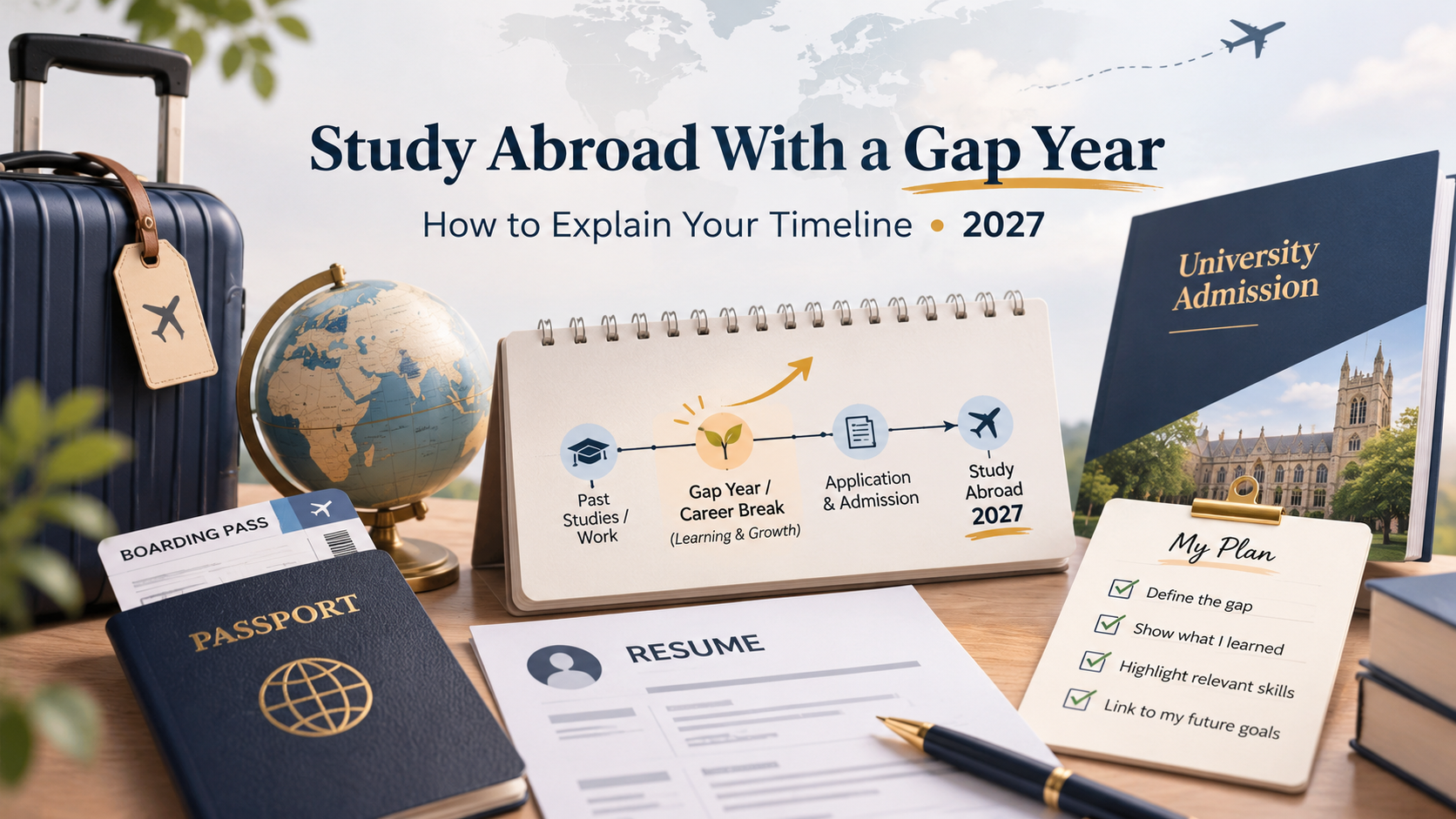
Study Abroad With a Career or Academic Gap in 2027: How to Explain Your Timeline
No, an education or employment gap will not automatically hurt your overseas admission in 2027. Most universities allow you to study abroad with career gap history if your timeline stays honest and well documented. However, eligibility depends on your target programme, your grades, and how clearly you explain the break. Unexplained gaps raise doubts, whereas verified proof builds trust.
Many Indian graduates and working professionals hesitate to apply abroad because their timeline is not straight. Perhaps you prepared for UPSC or GATE, cared for a sick parent, or paused work after a layoff. As a result, you might worry that admissions teams will reject your file right away.
In truth, global universities understand that real life rarely follows a perfect line. Admissions tutors and visa officers do not penalise honest pauses. Instead, they reject vague excuses, missing dates, and fake certificates. If you plan to apply for the 2027 intake, a clear and evidence-backed timeline protects both your admission and your visa.
1. Distinguish Gap Types and Programme-Specific Policies
Before writing a single word of your application, identify which type of break sits on your CV. Universities and embassies do not treat every gap the same way.
Short transitional gaps (under 6 months): Waiting for final results, serving a notice period, or preparing for IELTS rarely raises concern. Usually, one brief line in your Statement of Purpose (SOP) covers this cleanly.
Academic gaps (6 months to 2+ years): Taking time off between Class 12 and university, or between a Bachelor’s and Master’s degree, requires clearer context. Some competitive direct-entry undergraduate tracks restrict study breaks. By contrast, most postgraduate taught degrees focus more on your readiness today.
Employment or career gaps: Working professionals often pause between jobs due to downsizing, family business duties, caregiving, or burnout. Admissions committees generally accept career breaks when you explain what changed and why this degree makes sense now.
How Country and Visa Rules View Timeline Gaps
University admission is only half the process. Visa officers also review your full education and work history closely.
Australia: Under the Genuine Student (GS) requirement, the Department of Home Affairs asks targeted 150-word questions about your background. Officers look closely at study gaps of more than two months during an academic year, and they give much more weight to claims backed by real documents.
Canada: Immigration, Refugees and Citizenship Canada (IRCC) recommends adding a Letter of Explanation to your study permit file. You can use this letter to explain your study goals and any unusual pauses in your timeline clearly.
United Kingdom and USA: UK universities often review gap timelines before issuing a CAS, while US consular officers check your work and study dates on Form DS-160. Therefore, your academic application and your visa paperwork must tell the exact same story.
2. Document Work, Care, Examinations, Upskilling or Personal Circumstances
Admissions officers trust paper trails more than emotional promises. Consequently, you should match every gap on your CV with clean, verifiable evidence before applying.
Use the table below to see which documents work best for each common gap type.
Gap Reason
Acceptable Supporting Evidence
What to Avoid
Competitive Exam Prep (UPSC, GATE, CAT)
Admit cards, scorecards, or official coaching enrolment receipts
Calling an unsuccessful exam attempt a “research sabbatical”
Family Business or Freelancing
GST registration, client invoices, bank payment trails, or tax returns (ITRs)
Submitting an unverified letterhead with no proof of actual work
Medical or Family Caregiving
Brief doctor summary or discharge note (only if requested)
Sharing overly graphic private medical details in your main SOP
Upskilling and Certifications
Course completion certificates, GitHub code, or a live project portfolio
Listing ten passive video courses with zero practical output
Layoff or Job Search
Relieving letter, severance notice, or proof of upskilling during the search
Stretching your last employer’s end date to hide unemployment
Keep your privacy intact when health or family issues caused the break. For example, stating that you managed a family medical recovery is completely fine. You never need to overshare sensitive details just to prove honesty.
Above all, never buy a fake experience letter to fill an empty year. Universities and embassies routinely call past employers or verify tax records. One fake document can trigger an immediate visa refusal and a multi-year entry ban.
3. Build a Truthful CV, SOP and Reference Narrative
When you plan to study abroad with career gap periods, consistency beats clever wording every time. Even a tiny date mismatch across your files creates instant doubt.
Keep Every Date Aligned Across Four Documents
First, format your CV using exact Month and Year dates (for example, June 2024 to May 2025). Listing only years looks like you are trying to hide a missing ten-month stretch.
Next, cross-check those exact months against four key records. Your employer relieving letters, your SOP timeline, your Letters of Recommendation (LORs), and your visa forms must match down to the month.
Give the Gap Proportionate Space in Your SOP
Many applicants make the mistake of turning their entire SOP into an apology letter. However, your gap is just background context, not the main theme of your essay.
Follow a simple, calm sizing rule instead. For a break under six months, use one short sentence. For a gap lasting one to two years, write three to four focused sentences right where the break sits in your timeline. If a university offers an “Additional Information” box, place longer explanations there so your main SOP stays focused on your future course.
As UK postgraduate guidance from Prospects notes, universities want to see how you addressed past gaps and what makes you ready for study now. Use a clear three-step flow: state what happened plainly, note what you did during or after that period, and link directly to why you are applying for 2027.
Align Your Referees Early
Brief your academic or workplace referees before they upload your LORs. Share your updated CV and dates with them so they do not accidentally write the wrong graduation year or job tenure. Moreover, if you worked in a new role or completed a supervised project after your gap, a strong LOR from that supervisor proves your current readiness.
Before and After: How to Explain a Gap Honestly
Seeing real phrasing makes a big difference. Below is an anonymised, illustrative example showing how an Indian graduate can reframe a 14-month break cleanly without inventing outcomes or exaggerating facts.
Weak Narrative (Vague and Defensive)
“After graduating in 2024, I unfortunately faced some personal problems and could not find a suitable job in my field. Because of this difficult gap period, I stayed at home to focus on self-development and reflect on my life. I apologise for this break in my career, and I now wish to join your university to restart my future.”
Why this fails: It sounds apologetic, gives zero verifiable facts, and leaves the admissions tutor wondering what the student actually did for over a year.
Strong Narrative (Factual, Concise and Forward-Looking)
“Between June 2024 and August 2025, I paused my job search to support a family health recovery and manage daily billing and inventory for our family’s retail business in Pune. Handling supplier accounts showed me how poor demand forecasting hurts small margins. Once family responsibilities stabilised in September 2025, I completed a structured SQL and Python analytics project analysing retail sales data. This hands-on work confirmed my readiness for an MSc in Business Analytics for the 2027 intake.”
Why this works: It explains the exact dates honestly in four crisp sentences. Furthermore, it avoids oversharing private medical details, highlights real responsibility, shows recent academic preparation, and connects smoothly to the chosen degree.
(Note: This before-and-after example is purely illustrative to demonstrate clear narrative structure. Honest framing strengthens credibility, though final admission decisions always depend on a university’s full academic review.)
4 Common Timeline Mistakes That Hurt 2027 Applications
Even strong candidates weaken their applications with avoidable errors. Watch out for these four traps as you prepare to study abroad with career gap records.
1. Using fake internships or “friend’s company” letters: Officers quickly spot missing salary trails, generic job duties, and unverified phone numbers. A real, honest break is always safer than a fake job.
2. Applying without recent academic engagement: If you graduated four years ago and have not studied or worked in your target field since, take a structured course or build a documented project before applying. Recent output proves you can handle postgraduate coursework.
3. Letting the gap hijack your visa interview: During a US F-1 or university credibility interview, answer gap questions in two calm sentences and move straight to your course plan. Sounding nervous or defensive invites tougher follow-up questions.
4. Copying generic SOP templates: Admissions teams read thousands of Indian applications every cycle. Copy-pasted phrases about “finding your true passion during a break” immediately reduce trust.
A Quick Timeline Audit Checklist Before You Apply
Before submitting your 2027 university applications, run your profile through this five-step check.
Map every month: List every study period, job, exam prep phase, and break from Class 12 to today with exact start and end months.
Gather your proof: Match every break over three months with clean evidence such as admit cards, tax records, project links, or relieving letters.
Check programme limits: Confirm directly with each university whether your chosen course enforces strict recency or work-experience rules.
Sync your story: Verify that your CV, SOP, LORs, and application portal fields display identical dates.
Show current momentum: Highlight at least one recent skill, project, or workplace achievement from the past six to twelve months.
Frequently Asked Questions
Will an education or employment gap automatically hurt my overseas admission?
No, an education or employment gap does not automatically ruin your admission chances for 2027. Most international universities evaluate your whole profile, including grades, course fit, and current readiness. However, unexplained breaks or inconsistent dates raise doubts, so you must explain your gap concisely and back it up with honest evidence.
How many years of study gap are acceptable for a Master's abroad in 2027?
There is no universal global limit on gap years for Master’s degrees. Many universities in the UK, USA, Canada, Europe, and Australia accept applicants with two to five years (or more) between degrees if they have relevant work experience, upskilling, or a clear reason for returning to study. Always check individual programme rules.
Can I study abroad with career gap caused by UPSC, GATE, or government exam preparation?
Yes, preparing for competitive Indian examinations such as UPSC, GATE, CAT, or banking exams is a well-recognised reason for a gap. Keep your official admit cards, exam scorecards, or coaching receipts as proof, and explain clearly in your SOP how your preparation connects to your chosen 2027 Master’s course.
Do I need to explain a short 3-to-6 month gap in my Statement of Purpose?
Usually, a gap shorter than six months—such as waiting for university results or serving a job notice period—only needs one brief phrase in your SOP, or clear Month-Year dates on your CV. However, note that Australia’s Genuine Student form asks applicants to explain study gaps of more than two months during an academic year.
Will a career gap cause a student visa refusal?
A career gap alone does not cause a visa refusal when you present a truthful, verifiable timeline. Visa refusals happen when dates contradict each other across forms, when applicants submit fake work certificates, or when the chosen course makes no logical sense alongside past study or work.
Should I get a work certificate from a relative's company to hide my gap?
Never do this. Immigration departments and university compliance teams frequently verify employment through phone calls, salary bank transfers, and income tax records. If you genuinely worked in a family business, document it honestly with real financial or operational proof; if you did not, state your real activity truthfully.
We provide 360° Solution for your Education Needs. Contact us